
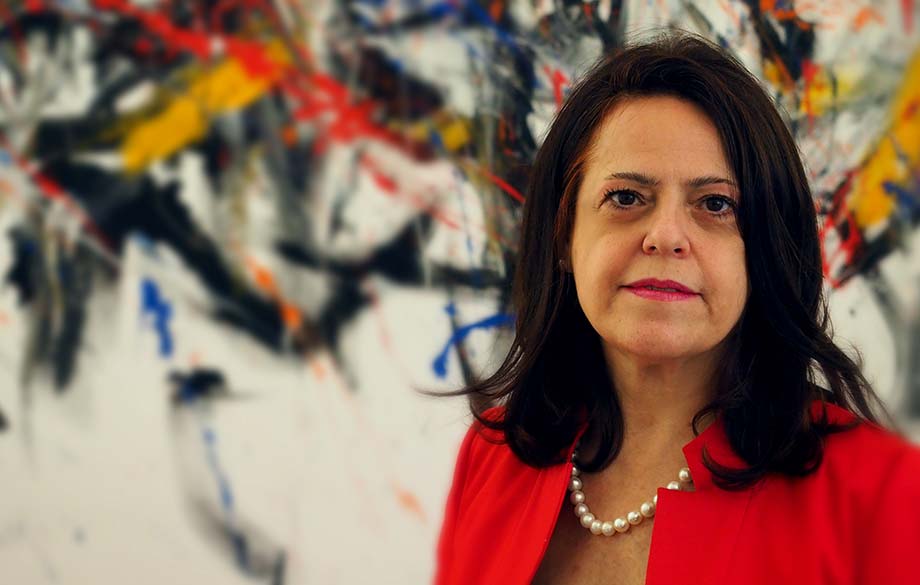
Being an engine in the exchange of skills and talent, of new ideas among the artists from Italy and Bulgaria - this is the most satisfying achievement for me.
After a Master’s degree in Literature and Foreign Languages in 1978 at University “La Sapienza” in Rome, she taught for some years in High Schools. In 1984 she won the European Exchange Program prize for Italy, becoming soon later an official trainer of teachers for Italian Department of Public Education. She obtained a Master’s degree in Cultural Management at University “Ca’ Foscari” in Venice and was appointed by the Italian Department of Foreign Affairs in 1998, to represent Italy for cultural matters in Shanghai (China). Her mission in China lasted three years. There she founded the first Italian primary School named "Gianni Rodari", along with the first Italian postgraduate course at International Shanghai University. In 2004 Mrs. Luigina Peddi was sent to Sao Paulo in Brazil, where she directed the Italian Institute of Culture, till 2009. That same year she was sent to direct the Italian Institute of Culture in Caracas (Venezuela). In 2013 he came back to the Italian Department of Foreign Affairs in Rome, to monitor the Science International Cooperation Unity. Since the beginning of 2015 she is director of the Italian Cultural Institute in Sofia.
- Mrs. Peddi, we are on the eve of the National Day of Italy - June 2, the proclamation of the Republic in 1946. How will you mark this date?
- You can easily guess how important this date is for all the components of the Italian system, including not only us but ICE, Confindustria and Camera di Commercio led by the Embassy. Every year, around this date, we organize the Italian Festival with initiatives coming from the different listed actors of this Festival.
This year we are proposing fashion, contemporary art and gastronomic exhibition, cinema and corto Festival, different sort of meetings with a graphic designer, a scientist and economic operators, contemporary Italian music, theater, Matera chorus, classic and contemporary literature, mostly in Sofia as well as in Plovdiv, Blagoevgrad, VelikoTurnovo, Balchik, Sozopol and Varna. For a detailed program the sites www.ambsofia.esteri.it and www.iicsofia.esteri.it can be consulted.
- The Italian Cultural Institute in Sofia was opened in 1950. How was it developed over the years?
- It’s a long path built up of little steps, at first with projects aiming to improve mutual knowledge of our cultures to integrate those aspects that were still unknown. The different locations in Sofia where the Italian Institute of Culture opened its offices tell enough of this history. From the first settings we grew in terms of interest among Bulgarian users and we had to split in two different places to allow students to follow our courses of Italian. Today they are held in 21 Patriarh Evtimii boulevard while the closer relationship with Bulgarian Institutions and above all the increasing need to schedule activities with the Embassy, forced us to move to the very town center: our offices today are inside the Embassy, with an independent entrance in 2b Parish Street.
- What is the development of our diplomatic relations in the field of culture at the moment?
- The spirit of collaboration is high and along with our Embassy, on 10th March, we have just organized an important meeting about the role of Europe, after 60 years from the Treaty of Rome. We’d like to thank for the collaboration of the University "St. Kliment Ohridski" and the participation of many representatives of the Bulgarian Department of Foreign Affairs. Another example comes from the art we expose in public places. If we devoted a respectful place to let the Bulgarian artists be well known like Assen Peikov, whose statue of Leonardo da Vinci welcomes everyone at Rome’s airport; the statue of Garibaldi has been preserved in the homonymous place in Sofia center, notwithstanding the recent projects to renovate the central area of the capital. Last but not least, the Bulgarian Institute of Culture in Rome has been opened in 2006, and we have an open dialogue to lead common projects.
- A bright event in Sofia in April was the opening of the exhibition "VIVA ITALIA! Italian Art of the XXth and XXI Centuries". What did you want to show to the Bulgarian audience with it?
- We wanted to share positive experiences and know how. Ups and downs are usual in the creative process of a country: it is true that Italy has given to the world the most important artists of the past, and it passed through difficult periods in the latest centuries. The blossom of innovation and creativeness came again after the terrible period of the Second World War, when everything seemed to be destroyed. The result is a mosaic of many different successful experiments, artistic currents, combination of materials, and contamination with other fields of art, from poetry to music, explored and exported to such an extent that they influenced art of other countries with more economic possibilities. The combination of these new elements is always accompanied by the presence of the symbols or recall to the memory of our past, fundamental to go on. With more than 100 artist exposed we are sure to have given evidence of this esthetic philosophy. This is the most important message we are proud to share with a country like Bulgaria, so merged into its glorious history and tradition.
- Apart from its fine art, Italy is also famous for its music. We, Bulgarians, adore it. What events do you plan in this area?
- Viva Italia shows the path of plastic/figurative arts in this latest 70 years, but we thought interesting to show the evolution of music as well.
Music changed a lot in these centuries: atonal, dodecaphonic, syncopated; sometimes very difficult to be heard, not only in Italy but all over the world, because of composers’ experience, dramatic and greatly contaminated by modern life rhythms. We offer an essay of Italian composers who lived those intense years, to accompany the exposition, as music has known different tendencies and influences. With this purpose we offer a concert of Italian electronic music on the occasion of the night of Museums: no limits, no boundaries to creativity.
- What about in the field of literature?
- The Furious Orlando, 500 years old, is a very welcome opportunity to let young students and not only, think about:
1) The great esteem that Italian tribute to Bulgarians since then. In fact Ariosto, the author of this Poem, dedicated two poem chapters to the glorious history of the Bulgarian king Vatrano and his people since then;
2) Techniques of visual communication experimented at that time: The Furious Orlando was the first bestseller at that time, after the Bible!;
3) Analysis of symbol used to transmit ideas;
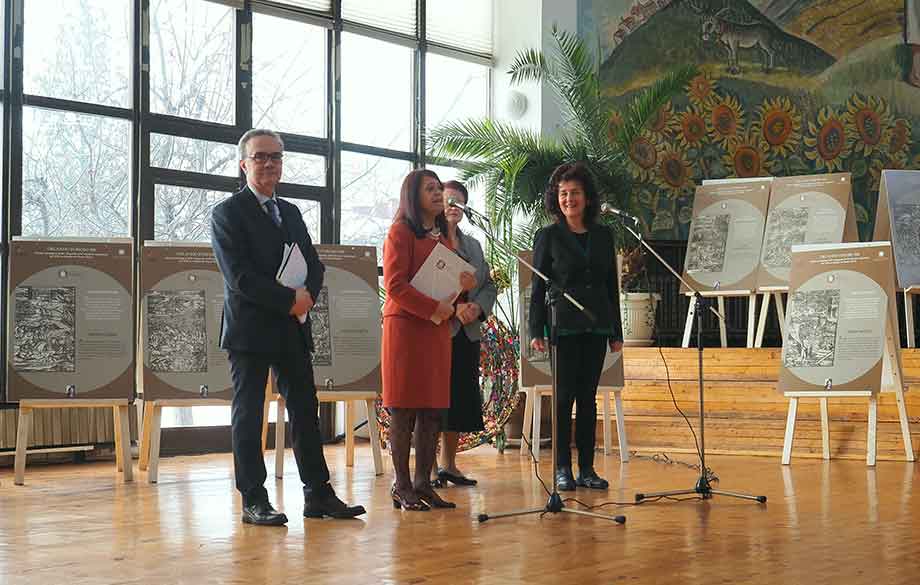
4) Comparison of themes and plots between old and contemporary literature. The exhibition is hosted in a school at present, the third to be precise, and is supposed to stop in three more schools of Bulgaria.
Luigi Pirandello, that is the father of modern theatre, will be remembered in his 150 anniversary.
We have invited Paolo Mazzarello a scientist who wrote the novel "The Queen’s Herb" to answer public curiosity about a particular Bulgarian plant treated in the book, since it has been translated into Bulgarian.
During the week from 16th October, dedicated to Italian language and culture, a cinema writer will be invited to accompany this delicate moment from literature to cinema in the evolution of our language.
The presentation of esthetic philosopher Giordano Bruno text "The Ashes Dinner", carefully translated into Bulgarian is going so well, that we are planning to publish a new different text of his writings.
The help given to editors and collaborators to translate Italian books into Bulgarian shows how wide and deep are the interests of local public: from history to literature, from art to science.
- What else to expect this year?
- Music has an important role: we join Bansko jazz festival with several bands and soloists. A harpist will be invited to play at the National School of music. Apart from the week of Italian language and culture, already described, the week dedicated to high way of processing and preparing Italian food and wine will be held from 20th November. Other two important dates are dedicated to the cultural heritage and the art of preserving them. The traditional cinema Panorama about the actual way of life in Italy with movies of the latest years is fixed for December, in 4 different cities besides Sofia.
- One of the main functions of the Institute is the dissemination of the Italian language. Are the Bulgarians interested in it? How many of our compatriots study Italian at the moment?
- We have answered a growing request of Italian language as told in advance: at present we count 2 314 people who are learning Italian for different purposes and at different levels, from the age of 6 up. Unfortunately, we have no data about students in private language schools in Bulgaria.
- What dreams do you have as director, what else do you want to achieve?
- We have organized concerts, theater representations, film making and art laboratories, photographic competitions and literature readings, involving Bulgarian artists and not, encouraging them to join these events with their creativeness. New ideas have enriched the same experience of Italian artist who came here: this is the real goal of my presence here. Having been the starting of a propulsion engine of a real exchange of skillful talent and above all the power of ideas to be shared, is the most satisfactory achievement I wish.
- Which Bulgarian cultural achievements impress you?
- At first the deep competence and great care of Bulgarians in speaking Italian impressed me a lot, later I found out you have this gift with foreign languages, maybe thanks to the different phonemes your language is rich with. I used to tell my friends in Italy that the passion for literature, joined to this gift for languages led to preserve the open second hand book market in Slaveikov Square, where you can find books in many languages. On the other hand, bookshops here are not supermarkets for printed pages to be quickly paid, but meeting places where people really meet, open books and read pages, with welcoming little sofa or chairs to speak or have coffee together with friends, either books or people. Even young people are keenly informed on politics and many topics like economy, unlike the European average. The concentration of theaters in the center of Sofia, compared to the percentage of people or square meters is really a challenge for many other capitals. I even tell my friends about your national pride: the referendum to substitute the Cyrillic alphabet with the Latin one (like other countries did) has never been taken into consideration. Moreover, apart from being great authentic and competent lovers of music, the national dance is widely practiced not only in private or public schools but, I personally verified, on every nice occasion. People spontaneously switch a tape on and start dancing, taking each other’s hands: this is really beautiful.
|
|
Photos: personal archive
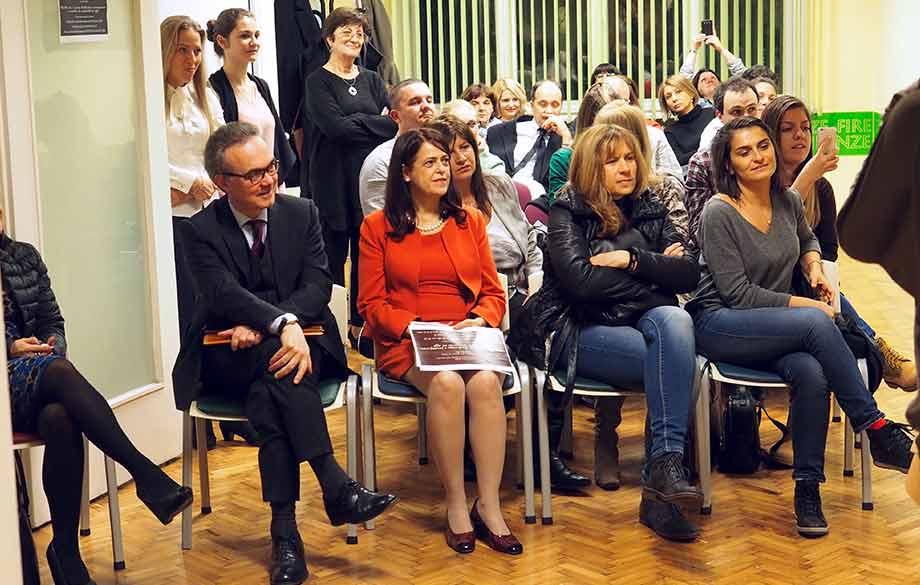
1. H. Е. Mr. Stefano Baldi, Ambassador Extraordinary and Plenipotentiary of the Italian Republic to the Republic of Bulgaria, Mrs. Luigina Peddi, Director of the Italian Cultural Institute - Sofia, Mrs. Velichka Velyanova and the translator Elsa Hadjiiska at the opening of the exhibition "The Furious Orlando"
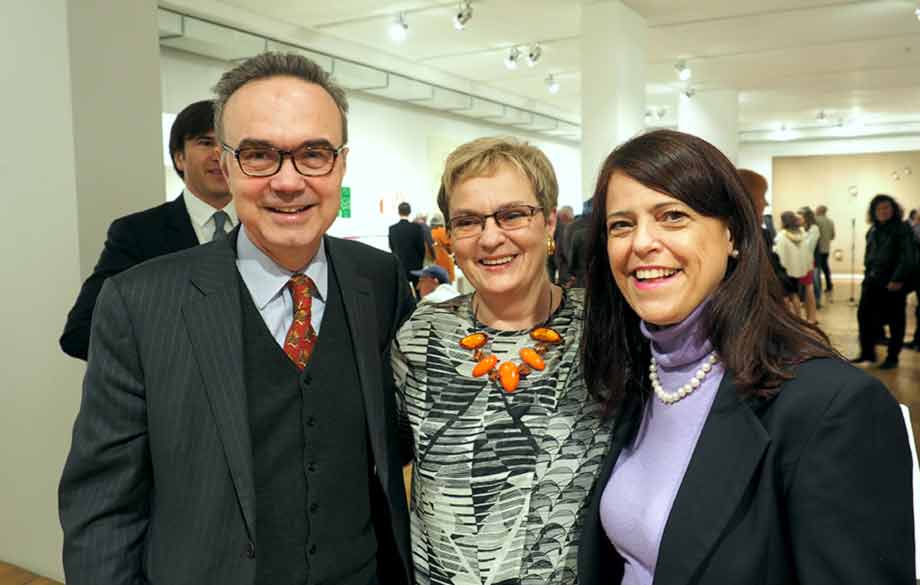
2. H. E. Mr. Stefano Baldi, Mrs. Adelina Fileva, Director of the Sofia City Art Gallery and Mrs. Luigina Peddi at the opening of the exhibition "Viva Italia!"
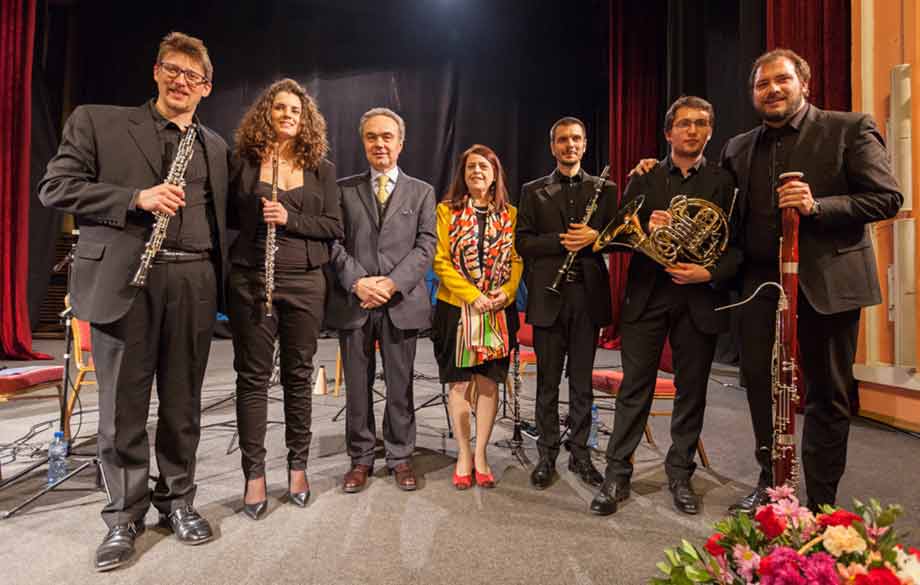
3. H. E. Mr. Stefano Baldi and Mrs. Luigina Peddi with the "Anemos" wind quintet at their concert at the Central Military Club in Sofia in February
4. H. E. Mr. Stefano Baldi and Mrs. Luigina Peddi at an event at the Language Center of the Italian Cultural Institute in Sofia


